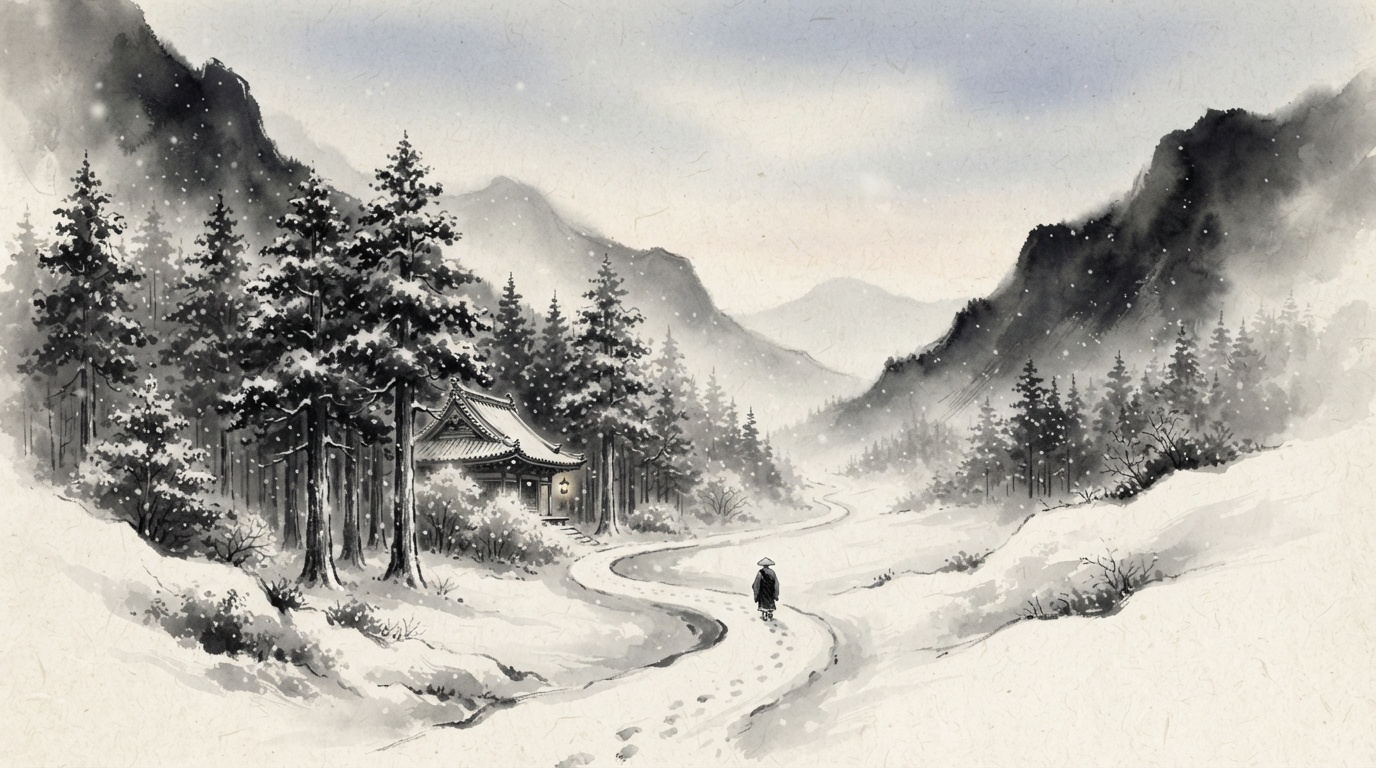
Ten people who made Zen — and the country that made them.
Ten chapters, from a thirteenth-century monk who cooked rice in the snow to a nineteenth-century wanderer who gave his clothes away. For readers who have never studied Japan.
2,900 words, delivered to your inbox. Then one email a week while the book is being finished. Unsubscribe in one click.
You have read the Zen books. This is the history.
Most of what is written about Zen in English was written in the last sixty years, by people who were themselves looking for something. That is a legitimate way to meet Zen. It is not history.
The men who actually built it in Japan were not calm. They were stubborn, often ill, frequently in trouble with the government, and they lived in a country being rebuilt by violence. What they argued about — whether practice is a means or an end, whether a monastery should take the shogun's money, whether a dying man can be helped — were live arguments with consequences.
This is that history, told through ten people, one at a time. No prior knowledge of Japan assumed. No Japanese required.
The ten, in the order they are written.
Each chapter begins in one place, at one hour, with a person doing something ordinary — cooking, waiting, arguing, dying — and works outward from there to the country around him.
-
The monk who was told he did not understand what practice was, by an old cook buying mushrooms.
-
02 Hōjō Tokiyori 1227–1263
The regent who ran Japan from a small room, and the teacher who would not flatter him.
-
03 Ashikaga Takauji 1305–1358
The general who destroyed the order he served, and the monk who buried the dead on both sides.
-
04 Ikkyū 1394–1481
The monk who mocked his own temple, drank, and wrote poems about desire that his sect has been explaining away ever since.
-
05 Takeda Shingen 1521–1573
The warlord who kept a Zen master in his camp, and what the master said when the temple burned.
-
06 Oda Nobunaga 1534–1582
The man who ended the age of monasteries, and the abbot who stayed in the fire.
-
07 Takuan Sōhō 1573–1645
The monk who told a swordsman that a mind stopped in one place is a mind that can be cut.
-
08 Date Masamune 1567–1636
The one-eyed lord who sent a ship around the world, with a monk at his elbow the whole way.
-
09 Hakuin 1686–1769
The monk who gave the world the sound of one hand, and spent his life sick, furious and awake.
-
10 Ryōkan 1758–1831
The wanderer who gave away his clothes, played with children, and left almost nothing written down.
What you get
- Ten chapters, 2,500–3,500 words each — about 30,000 words in all. A short book, not a pamphlet.
- A timeline of the eight centuries covered, on one page.
- Maps for each chapter: where the person lived, and what was within a day's walk.
- An annotated reading list: the primary sources, the translations worth your time, and which "facts" in circulation are legend.
- Audio for every chapter, read by a native speaker, about twenty-five minutes each.
- PDF, EPUB and Kindle — no app, no subscription, yours to keep.
Three rules I hold myself to
You can check all three in the first chapter.
-
1
Legend is labelled
Where a famous story cannot be traced to a source near the person's own lifetime, the chapter says so, in the sentence where it matters — not in a footnote you will not read.
-
2
The person comes first, the history second
No chapter begins with a century. Each begins with a room, a meal, an argument — and then works backward to the country that produced it.
-
3
No national character
There is no claim anywhere in this book about what "the Japanese" are like. Ten men, one country, eight hundred years — that is enough.
The offer
One payment. No subscription, no upsell, no bundle.
| What | Price |
|---|---|
| Chapter oneThe whole chapter, PDF and audio | Free |
| A single chapterAny one chapter from two to ten, PDF and audio | $9 |
| The full book — early readerAll ten as they are finished, plus timeline, maps, reading list and audio | $29 |
| The full bookThe same, once the early-reader window closes | $39 |
The first 200 buyers, or the first fourteen days after this page goes live — whichever comes first — pay $29 for the whole book. When the window closes the price goes to $39 and stays there. The change is announced here and by email before it happens, and the book is never discounted again.
Chapter one is finished. Chapters two to ten are released one a week, in order, and every buyer of the full book gets each one the day it is done, at no further cost. You are not pre-ordering a promise; you are paying for a book in progress, at a lower price, and you will see the next chapter within seven days of buying.
Questions
Do I need to know anything about Japan?
No. Every term is explained the first time it appears, in the sentence where it appears. If a chapter uses a word you cannot picture, that is my mistake, not yours.
Is this a religious book?
No. It is history. Whether these men were right about anything is left as an open question, which is how they left it.
How long does the whole thing take?
One chapter a week. Chapter one is written; the rest are in progress, and you will see each one as it is finished.
Can I read it on a Kindle?
Yes — EPUB, MOBI and PDF, without DRM.
Is the audio included?
Yes, every chapter, about twenty-five minutes each.
What if I buy the full book and do not like chapter three?
Ask within thirty days and you get your money back, no questions, and you keep the files.
Eight hundred years, ten rooms.
Every chapter begins in a specific place, at a specific hour, with a person doing something ordinary. That is the only way I have found to write about a subject this large. Start with the first one.